





Quick Summary
In this first Peru dispatch, Tristan LaHaye rides from Ecuador’s border through northern Peru’s dusty desert to the surf town of Puerto Malabrigo, then visits the world’s oldest Casa de Ciclistas in Trujillo before heading up a tunnel-riddled canyon road to Huaraz. From there, he and a shrinking crew of bikepackers set out on the Conexión Oyón start of the Peru Great Divide in rainy season, facing lightning and snow on a 4,800m pass, a broken rack, a motorbike collision, and food poisoning, with a magical hot-spring camp in between. He ends in Oyón to rest and wait for a friend, weakened but eager to take on the hard stretch ahead.
Words and Photos by Tristan LaHaye @baby.ogre.motor @rollingtides.rt
This is the thirteenth post documenting the surfpacking / bikepacking / backpacking adventure that began with Rylie and Tristan starting in different parts of the world, rejoining in the US, and making their way to Central America. Now, Tristan continues the journey solo again until the end of the road in South America. Read about the ambitious journey in Part 1 HERE, Part 2 HERE, Part 3 HERE, Part 4 HERE, Part 5 HERE, Part 6 HERE, Part 7 HERE, Part 8 HERE, Part 9 HERE, Part 10 HERE, Part 11 HERE, and Part 12 HERE. Tune in each month to see how it's going.

I’m welcomed into Peru by a dog gnashing at my leg, almost taking out a chunk. He’s supported by his two buddies flanking me. I jolt off my bike in fear, yelling back at their barks instinctively. Dust kicks into my eyes and motorbikes buzz by, nearly clipping me. I ask for water from a hose and am met with hostility.

The welcome into Peru is still warm, if only in the literal sense. I’ve left the wet mountains of Ecuador and descended into an arid desertscape. From here, I’ll be trading mountains for headwinds as I battle my way towards the coast in search of some surfable waves. I haven’t seen the Pacific since Panama, and I’m stoked to get back in the water.

But first, the desert must present its trials and tribulations. I roll into a town with a combination of feelings I haven't fully experienced since Mexico- a throbbing headache, honking horns, barking dogs, and dust clinging to my sticky skin. I’m overwhelmed, hungry, and dehydrated. I try to keep my composure and think, but my brain has turned to mud.

The sun is setting. Refuel, resupply, reset. What do I need? Hotels are too expensive; that's a no-go. The local police told me to camp in the main town square. “It's safe,” they said. I was hopeful, but it’s the epicenter of chaos - street vendors, blaring speakers, and bouncy castles. I reminisce about a time when I had the energy to play in those bouncy castles. Seems like a long time ago.

I feel the attention of everyone within view, who point and snicker at the tourist. I won’t be camping there for sure. Finally finding a restaurant, I filter water and refuel with some chicken and rice. Ahhhhh. Just what I needed. My thoughts slowly become more coherent.

For camping spots around the world, there are two resources I use almost daily: ioverlander and rollingaround. Both these apps allow users to share waypoints of all kinds to help others along their journeys. As I finish up my meal, I find a promising camping waypoint 10km away, by a reservoir. My recent memory of biking 10km involved teeth-clenching, forehead-dripping grit, all at a pace slower than I dare admit. And so, I hesitate to make the detour for a good sleep. However, as I ride into the darkness, I realize this dread was misplaced. The air is cool, and the ease of momentum with no headwind feels so fresh, so pure. I slowly come back to myself, and don’t skip a beat when I find the reservoir’s edge crawling with ginormous red ants. I prowl around for an ant-less patch of ground, set up the CrossPeak 2, take a soothing bath in the water (thinking of caymans), and fall asleep as soon as I go horizontal.

I awake to wonder. I always love waking up somewhere after arriving in the dark. It feels like being transported into a new world. The sun shines through the tent, rousing me to admire the reservoir, looking incredible in the soft morning light. What a contrast from the chaos of the day before. I sit in stillness, dripping from a morning dip. This, I tell myself, is what it's all about. Welcome to Peru.

After a week of desert headwinds, I finally reach the ocean. There’s a vibrancy to towns that have access to some sort of body of water. This place is no different. Music jams from different speakers as people play in the waves, lounge on the beach, or drink beers on the pier. I relish in the newness and the familiarity of it all.

This northern stretch of Peruvian coast is renowned for its long left-hand point breaks. In fact, when the swell lines up just right, it’s home to the longest surfable wave in the world. It’s smooth and relaxed, perfectly suited for my sub-par surf abilities. I spend a week in Puerto Malabrigo with a friend, spinning laps in nature’s wave pool. I catch a few waves, crawl back onto shore, and tackle the long barefoot hike back out to the point to do it all again. It’s not exactly restful, but it’s blissful.

A Casa de Cyclista is a place, usually someone’s home, where they host traveling cyclists. It's a place to rest, connect, and meet people who share the same love of travel by bike. Trujillo, the next city to the South, is home to the oldest Casa de Cyclistas in the world! Lucho and his family have been hosting bike travelers since 1985! (If I could put 1985 in all caps, I would). They have piles of logbooks from the thousands of travelers they’ve hosted throughout the years, all filled with unique stories of adventure. Reading through the past entries reveals a magic of the old way of travelling, before GPS and 5g. People describe specific camp spots and how to get there. They leave the names of connections they made and how to find them. Their stories feel so rich; the serendipities in their travels likely feeling even more synchronous. No waypoints on ioverlander, that's for sure.
Lucho, the legendary host, shared his passion for cycling with his son, Lance. In 2019, Lance tragically got hit by a car while biking on the highway and died. He was only 12. I pass his memorial as I head south, unsure how to feel. Lance, you’re remembered, buddy.

I'm eager to leave the busy highway and head up into the hills again. An empty stretch of pavement carries me up a wide valley until it turns to a narrow, dusty dirt road built into the sides of a steep canyon. Illegal mining trucks barrel along with no concern, and I often have to stop to squeeze myself against the sheer rock face to avoid getting nicked. This side of the road is better than the other, though, where it drops off about 300m into the gorge below. There are over 35 single-lane tunnels to pass through, no more than bored holes through rock. I turn on my headlamp as I pass through each of them, hoping I don’t hear a truck headed my way. I use my headlamp in the darkness, and at the end of the day I put it in my pocket. It stays there for a few minutes until I feel a sudden heat on my leg - the headlamp burned a hole through my shorts. Hah! Silly move.

My camp spot feels special, tucked under the roof of an adjacent tunnel, on the very edge of the gorge. The ground is too firm for stakes, so I use some lightweight paracord to secure my tent to a climbing bolt in the rock wall. This way, my home won't go sailing into the abyss. I still need to be careful when I get out to pee, though, as I’m only one short stumble away from a long way down.

A few days later, I roll into the bustling mountain town of Huaraz, which serves as a basecamp for many of Peru’s most incredible hikes. It’s also the official start of the Peru Great Divide bikepacking route. It's a 1600km high-elevation route that runs through the heart of the Andes and includes upwards of 50 4000m+ passes. For me, it’s the holy grail of bikepacking. Remote dirt roads, blue lakes, rugged mountains–all the elements to make me feel at home. The only hitch - it's the rainy season. A few months ago, you could tackle the grueling challenges of the route in perfect weather, camping high in alpine meadows. Now–well, I don’t want to speak too soon, we’ll see how we go.

There are lots of other cyclists in Huaraz, and we plan to set off together as a group of six. Instead of taking the original start of the Peru Divide (which immediately drops 3000m into the valley only to climb straight back up again) we take an alternate route - Conexión Oyón. Due to the flu, two members of our six-pack stay behind. We haven’t even started, and our group is already shrinking. Stocked up on dried fruit, coca leaves, sweet potatoes, and peanut butter, our cheery group sets off to see what the hype is all about. There are the boys, me and Jason, an American who’s been riding down from his home in San Francisco. And the lads, the British duo of Ben and Dan, who I’d ridden with in Ecuador.
Peru is notorious for questionable food hygiene and sickness. The lads have already had their fair share of food poisoning in the few weeks of being in Peru. Inspired by Jason’s vegetarianism, we decide to avoid meat whenever we can, surely that will keep us healthy. Still though, my stomach is feeling funky.

Our first night, we camp under the blessed roof of an old building at the foot of the mountains (The foot of the mountains here is apparently still at 4160m above sea level). Ben opens his panniers to find his fancy jar of peanut butter has spilled over all his things. What's more, he starts feeling awful and sick, and we fear we’re losing another member of the team. He goes to sleep early with a gnarly fever.

I wake in the early morning, before the sun. It sounds like the other guys are also tossing and turning in their tents. My mild sleep apnea is exacerbated greatly at high elevation, and as we’re still acclimatizing, it can be difficult to breathe.
Somehow, Ben rallies from his feverish night of flu and decides to push on. He leads our pack up the countless switchbacks, higher and higher and higher. We chew coca leaves to help with the altitude. Although coca leaves are what’s used to produce coke, the two are as different as hemp and marijuana.
Coca leaves are a medicinal superfood and have been traditionally used for over 8,000 years in the Andes. It is a mild stimulant that can aid in digestion, altitude sickness, pain relief, and also packs a punch of vitamins. We pass around Jason’s overflowing bag of leaves while biking, sharing in the energy boost for our already-exhausted selves. Up near the top of the pass at 4800m, Jason peels off for a detour to see a glacier up close. Fearing the rains, which usually hit hard in the afternoon, I push on with the lads.

On this stretch of road last year, a lone bikepacker was struck by lightning. His memorial is displayed at the bikepacker hostel where we rested in Huaraz. Our kind host there (mother to all bikepackers) warned us to avoid this route and the threat of lightning. Driven and naive as we are, we kept our course. All this feels fine until, seemingly out of nowhere, I see a huge bolt of lightning strike just ahead of Ben’s silhouette, followed by its thunderous roar. Uh oh. A survival instinct, fear, and somehow, the pure joy of adventure courses through me.

Our whole group is split up at this point, everyone fighting for themselves to get over the pass as the skies unleash. Hail peppers us, then rain, then snow. In a mere matter of minutes, the valley below is caked in a layer of white, exactly where Jason would be. He’s stuck in the thick of it. Trusting everyone will fend for themselves, and needing to keep moving to keep from freezing, I push up and on. The only way through is forward, as there’s no shelter to be found up here. I carry the memory of the bikepacker who was struck; he’s probably on all of our minds now with the thunder rolling around us. This was a real risk, a gamble, and yet I can’t help but surrender myself to the will of the Andean Mountain gods.
We all thankfully make it to a small town in the valley below, where a 5$ room and no running water feels like a luxury. Ahh, the sweet, sweet contrasts of life on the road. Jason spends all evening under the blankets, trying to regain sensation in his fingers and toes.

The next morning, our four pack gets whittled down to three, as Dan has come down with a fever and is puking in the courtyard. We leave him behind to rest and catch up another day on an easier stretch of road, and the three of us that remain start the climb towards a big hike-a-bike. We only make it a few hours before Jason stops. His entire rear rack had broken, and despite ample zip ties, wire, and ski straps, there’s nothing we can do to get it fully functional again. Reluctantly, Jason points his wheels downhill back towards town to find a welder. Ben and I look at each other and laugh. And then there were two.

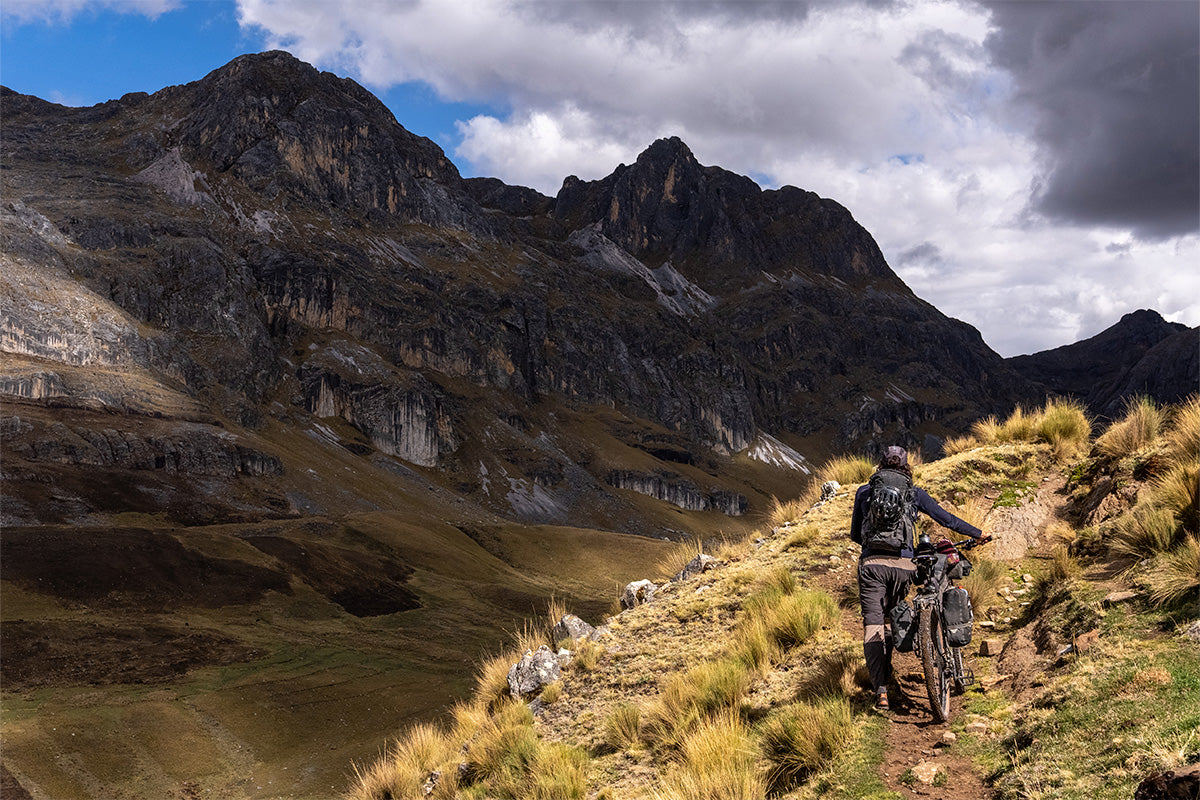
We pedal until the end of the road and load up our backpacks in preparation for a chunky hike-a-bike. I easily slide all my sleeping stuff into my Elevate 22 and use the bungee cords to hold my helmet in place for the walk. We scramble down a rocky trail and start side-hilling along a little cow trail. There are no roads in this valley, and it feels special, muy tranquilo. We’re also blessed with a miraculous lack of rain that would have otherwise had us slipping and sliding our way down the hill below. Already we’re not very graceful, dragging our poor steeds along beside us.
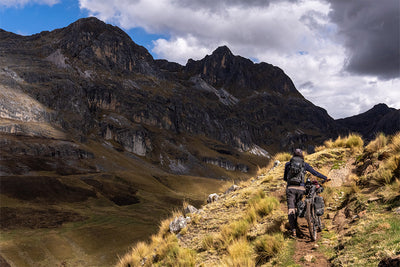
After covering the 5.5km hike in three hours, a road appears seemingly out of the blue. It's steep and rough, but we’re just glad to be pedaling again. At the top of the pass, we fill up on clean mountain water before following a majestic descent into the next valley. The sun burns the landscape orange as we zoom along, bundled against the cold. We head toward a point on the map labelled “hot springs” and really don’t know what to expect.

It ends up being better than we could have ever hoped for: a steaming little stream comes out of the ground and snakes down the valley. We feel the warmth of it as we approach and excitedly set up our tents right beside it. It's perfectly hot, and a little way downstream I find a pool big enough for soaking. Ben and I lay side-by-side in the hot water, laughing up at the stars. Mountain silhouettes reflect off the glassy water, and we reflect on all the micro-moments that led us here. We are in the most magical hot tub in the middle of the Peruvian Andes after really grueling days. We could not be more relaxed.
After a good morning soak, we pack up and get ready to bike again, fighting every instinct to just nap in the warm pools all day. As soon as we’re on our bikes ready to set off, the skies unleash a torrential frigid rain. Welcome back to reality.

Reality hits us even harder when a speeding motorbike slams into Ben later that afternoon. Everyone hits the ground hard. It’s a miracle Ben is uninjured, and we lend a hand to the two scraped-up motor bikers. Drivers in Peru can be really dangerous. He didn’t even hit the brakes as he sped towards Ben, who was trying to get out of the way as we crawled slowly uphill on the quiet dirt road. Everyone is okay, though, and incredibly lucky. The motorbike is pretty banged up, so we give them some cash to help pay for repairs. An ambulance promptly arrives and takes the two locals away (I’m impressed at the quick response in such a remote place), and we finally get the chance to assess the damage to Ben’s bike. I thought his front wheel would be shattered, bent beyond hope, but his huge pannier took the bulk of the impact. It only exploded everything he had in there, bending his rack and breaking a few spokes. We roll away counting our lucky stars, more than a bit frazzled.
After what feels like the longest 20km of my life, we roll into another little mountain town, where someone offers us a little concrete room to sleep in. I’m starting to feel quite weak, and within an hour I’m throwing up in the backyard, shaking, and sweating. Jason and Dan arrive after dark, having taken the more direct route to meet us. We all squeeze onto the cold floor to try and sleep, and I’m not the only one feeling awful. Ben and I trade places on the toilet all night, and moan in pain when we lay back down. The toilet doesn’t flush, and so the foulness of the night accumulates with every passing hour.

There’s another town 18km away where we can rent a room, and in the morning that becomes our sole focus. I crawl my way there, exploding at both ends every few minutes. I don’t remember a harder day on the bike–it’s terrible. We make it eventually, though, and I sleep a solid 14 hours, waking up feeling significantly better. I think of resting another day, but decide to hit the road, knowing a bigger town and lukewarm shower awaits us.
Slowly, we climb our way up another pass along a spectacular valley. Perfect lakes lie everywhere, and I can’t help but imagine the CrossPeak 2 pitched by their shores. As we climb higher, the mining activity that is such a big part of the Peruvian economy becomes hard to ignore. Huge machines dig into the earth, backdropped by the most beautiful glaciers you’ve ever seen. It’s a cruel duality. It makes me sick. Then I think of the phone in my pocket, the bike that I ride. Where did these minerals come from? The world is not so black and white.
In the small town of Oyón, we find refuge in a cute little hostel. We’re all ready for a few days of rest. I’ll be here for even longer, waiting for a good friend to join for this daunting stretch of the Peru Great Divide. Endless climbs await us, and I still feel weak from the sickness. I’m scared, but it’s a good scared.