Quick Summary
Peter Gierlach answers his own despair over unchecked development and light pollution by hiking to Pharaoh Lake in New York's Southeastern Adirondacks, a landscape that was once clearcut by loggers and treated as a playground for wealthy industrialists. After New York's 1894 "Forever Wild" clause brought the land into state hands, a century of minimal management let the forest, wildlife, and quiet return, leaving only footpaths, hidden bridges, and lean-tos as signs of people. Gierlach argues that Pharaoh Lake shows how wild places can heal when we choose to leave them alone, and that what happened there could happen anywhere.
Words, Photos, and Video by Peter Gierlach @petegabbytravel
 What could happen if, for just one second, we stopped developing every square inch of land at our disposal? What if we chose to preserve wild spaces instead of destroying them? What if we mustered up the courage to protect them in the face of industry?
There’s plenty of reason to despair about the state of our natural world. We’re stripping resources at ridiculous rates. There are deserts used as landfills for our unwanted (and often unused) clothes. The planet is warming rapidly. The night sky is disappearing.
For me, the despair hit deepest when I returned from a hiking trip to Glacier National Park. My friend’s wife picked us up from the airport around midnight and drove us back to their place. Just twenty-four hours before I had been laying on the shores of an isolated lake, staring up at the unobstructed night sky. The Milky Way lived up to its name. The water and stars were both so clear that it was hard to tell which way was up and which was down. I felt both immense and minuscule at the same time. It was as if the universe was welcoming me into its own personal performance - a sign of trust and respect for an appreciative guest.
But I was no longer there. Instead, I was staring out the window at bright LED lights glaring along the roadway. I decided to look up at the stars to capture the magic from the previous night. Instead, I was blinded. Looking down, I found the source: the brightly lit Ashley Home Furniture parking lot. There wasn’t a soul to be found anywhere in the vicinity and yet this half-acre of asphalt was lit up like the Super Bowl.
Since then, to me it often feels like we’ve gone too far - that there is no coming back.
So where is hope to be found when we must search amidst strip malls, personal injury attorney billboards, and hideous gray monoliths that make us feel like prisoners in our own creation?
As is often the case, the answer lies beyond human reach.
 There is an area of protected forest that shows what can happen if nature is left alone. Once scarred by industry and stripped of its dignity by egomaniacal robber barons, it is now one of the most popular nature escapes in its Upstate New York. It has relegated humans to visitors instead of victors. It now reminds us of our rightful place in the scheme of things. And, most importantly, it provides a roadmap for healing the wounds we’ve cut in the name of comfort.
If we can learn the history of this place, and experience its present, we can dream of a future that is more sustainable and connected to nature.
In the mid-1800s, a patch of Upstate New York was being used heavily by the lumber industry. Various landowners sold rights to companies that made a living off destruction. Countless trees were felled, tied together, rafted down a lake and into the Hudson River to be mutilated in smog-filled factory towns. This was called Progress and was seen as necessary for the human condition.
 This little nest of land surrounded Pharaoh Lake, in the Southeastern Adirondacks. No one knows where the name came from (nor for Pharaoh Mountain, which keeps watch over the placid blue waters below). Surveys marked these as such by 1819, and beyond that they were often referenced in land sales to the industry.
The combination of logging and wildfires clearcut much of the land for the benefit of various industrialists. At one point, a Bavarian chemical magnate named Wilhem Pickhardt had planned to dredge up the land between Schroon Lake and Pharaoh Lake, roughly along the Schroon River, so that his large leisure boat could navigate unimpeded between his two playgrounds on a personal canal. The land was seen as a playplace for the wealthy, all while much of it was being cut down and trampled on through their greedy misgivings. God forbid wild species have a home or those not wealthy enough for a personal canal enjoy the space.
Some things never change.
Once Pickhardt passed away, the land around Pharaoh Lake passed hands between multiple lumberfolks through the early 1900s. It was at that point that the story of this beautiful region took a turn towards redemption.
As part of New York’s unique “Forever Wild” clause in the state Constitution, added in 1894, the state began purchasing land around the Adirondacks for the purpose of preservation. The Pharaoh Lake area, after passing around multiple lumber-scented hands, finally found its resting place with the State of New York as part of the larger Adirondack Park.
 Today, the Adirondacks encompass over 6 million acres of land - more than Glacier, Grand Canyon, Yellowstone, Yosemite, and Great Smoky Mountains National Parks combined. The Pharaoh Lake Wilderness Area lies on the southeastern end of the park, with the lake now protected from society by a significant buffer of wilderness.
For over a century this land has been allowed to heal. It has been managed minimally - typically only for trails, lean-tos, the occasional bridge, and wildlife management. No more lumber industry. No more shipping trees down the river. No more extractive equipment. Even the firetower atop Pharaoh Mountain was vandalized at its base and collapsed in a storm in the mid-90s.
 The area has been rewilded and restored. Maybe not to its former glory, but enough to that human influence takes a trained eye to catch. I wanted to experience it for myself. Because if this wilderness was able to heal over the past century, what could it mean for the rest of our planet?
Pulling up to the main trail before sunrise, the first thing I noticed was the silence. A century ago, I would have heard the songs of industry. Now, all I could hear was my own blood pulsing through my veins. Even the birds were quiet - still asleep in the early morning frost.
While the Wilderness Area includes a spider web of trails, my focus was on the Pharaoh Lake Trail - the primary thoroughfare from the Wilderness edge to the shores of the lake. Strolling along the trail felt like entering a quiet world found in fairy tales. The anxiety of society melted away a little more with each leaf that crunched underfoot. The world began as black, added just enough gray to see, ascended into a deep hue of blue, and finally burst into color as the sun approached the horizon.

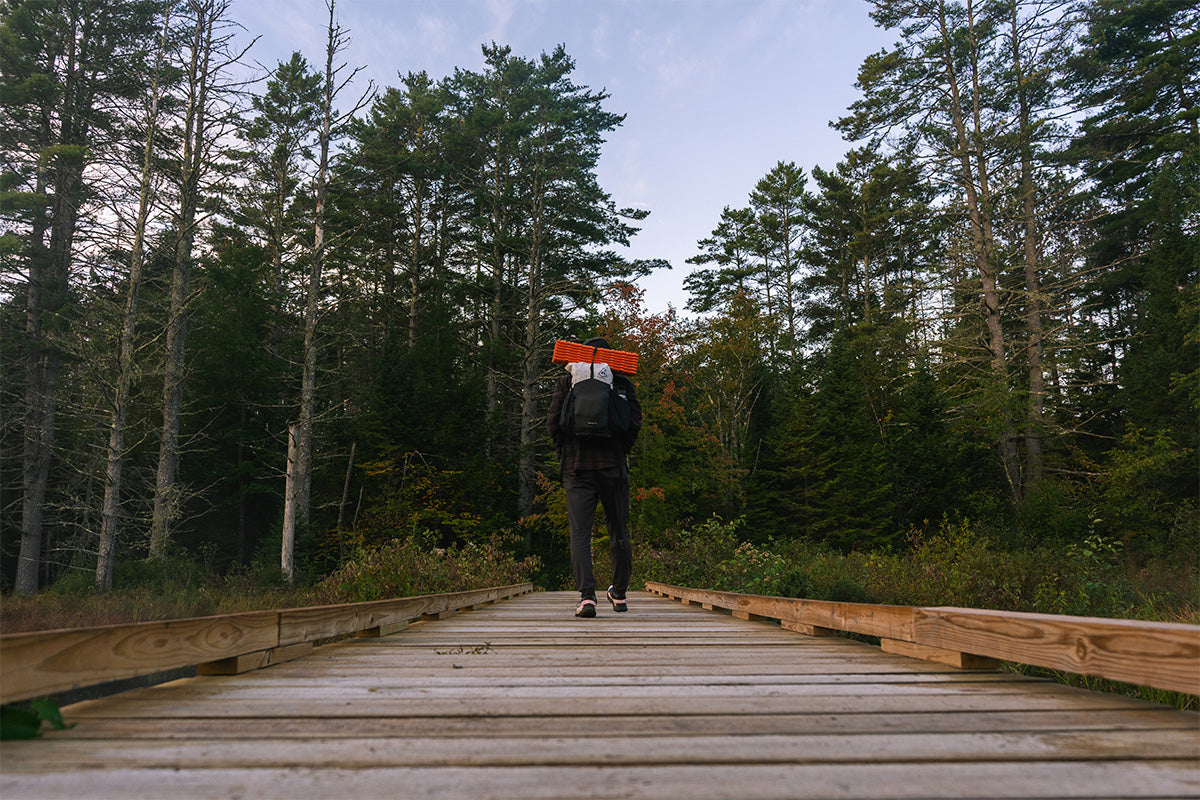
After about two miles I came upon a pile of lumber tucked against the edge of a marsh, underneath a “Bridge Out” sign. A couple years ago, an older bridge over the marshland had been washed out. Recently, it was rebuilt by the DEC. It’s not gaudy. Instead, it hides in the landscape. Walking across, it felt like I was part of the scene - just another lifeform in a grand cathedral of natural beauty. The mist rose by a mountain in the distance. Birds rustled to life in the marsh.
This is how this place should feel, I thought as I strode across the boards.
If you picture a pristine northeastern forest, chances are your imagination conjures up something similar to the Pharaoh Lake Wilderness Area. The trail was soft and dotted with the first autumn leaves. A mix of oak, hemlock, and pine bordered the trail. Flora and fauna and fungi - signs of life in an area that was previously unvalued for anything beyond profit - were plentiful. For the most part it was silent, with the sound of engines nowhere to be heard. It’s the type of place that makes you believe in the mystical. I’m sure I was being tracked by a gnome. Fairies had to have been hiding behind the leaves. It wouldn’t have surprised me if one of the large trees began following me with its gaze. I felt like a pilgrim on an important voyage, transported back to a time we’ve forgotten at our own peril.
 My destination was one of the lean-tos that dot the lake; a New York State staple with hundreds scattered across the region. These structures are hidden and easy to miss. From behind, they are moss-covered and blend perfectly with the landscape. As it should be. Lean-tos are a sign that humans have repaired their relationship with a place. It’s a statement that impact will be minimal, the shelter will only provide what is necessary, and that all stays are temporary. If you want to feel immersed in a landscape and get a sense of what it means to be a true local in the wilderness, spend a night or two in an Upstate New York lean-to. You’ll leave that site more connected to the land than you’ve ever been.
Arriving to the lakeshore is dramatic. First, you sneak up on Lean-to #1. Once you check and make sure it’s clear of inhabitants (both human and rodent), you turn around and walk to the edge of the tree line. From there, you have to take a slow, long, deep breath and hold it as you take in the lake that’s flat as glass, the mountains looming in the distance, the reflection of the landscape painted on the water, and the sounds of loons (at the right time of day) and splashing fish. After noticing all of this, only then can you relieve your lungs and smile.
You’ve made it. This is special.
This is exactly how I announced my presence at the lake. The ritual was followed by a long sit on a rock with my toes just above the waterline. A couple of canoes, available to anyone who thought to bring a paddle, were flung to my right. Even on the water, the human experience of Pharaoh Lake is manual, temporary, and silent. When you sit and think in a place like that, it’s easy to see why it’s so important.
Where concrete and construction brings despair, the Pharaoh Lake Wilderness sprouts hope. Just over a hundred years ago, much of the landscape was clearcut for industry. This jewel was extracted and defiled in the names of greed and development. It was a symbol of excessive growth and a complete lack of care for nature.
And now? Well, it couldn’t be much different.
 In the past century the trees have regrown, the wildlife has settled in to their rightful homes, and human infrastructure is minimal. It’s a small slice of Earth as it should be - natural, rugged, wild, free. Free from human meddling. Free from the smog of arrogance. Free from a broken future.
Now, footprints have replaced tire tracks. Lean-tos have replaced transport operations. Hidden bridges have replaced dredged canals and gaudy estates. Imagine, for a moment, what this means for us.
If we commit to leaving an area alone and allowing it to heal, the results are astounding. Wounds can scar. Life can return. Nature can reemerge. It’s easy to look around at our thoughtless destruction and feel that there is no other way. And yet, places like Pharaoh Lake challenge that assumption. They are an example of taking Yvon Chouinard’s advice of reaching the edge of a societal cliff, turning around, and moving forward in a new direction instead of marching towards oblivion. They show what’s possible when a group of people commit to preservation and treating the land with the respect it deserves.
 Natural places of awe, wonder, and peace can proliferate and enhance every aspect of our lives and society - if we choose for them to exist over data centers, warehouses, and housing developments.
If it can be done here, why not elsewhere?
Leaving Pharaoh Lake is always more bitter than sweet. I felt rejuvenated and at peace, but sad knowing that it would be awhile before I could return. At least physically.
Because every time I pass a site that has been torn to shreds and built into a fast-food chain, or my eyes are blinded by LEDs on a clear night, I don’t feel total despair. Instead, there’s a glimmer of hope. That’s because my mind can travel back to the water lapping along the shore, the mountains in the distance, the stars populating the sky, and the loon calling out a song of hope into the valley.
In spite of it all, it still persists. And so must we.
Pete Gierlach is a writer from upstate New York. He has spent much of his life exploring the forests of the Northeast, where he loves to backpack, paddle, and wander around any path his feet can find. He also runs the "Slow and Strenuous Dispatch", which focuses on living well in our fast-paced world. You can read his work at petegierlach.substack.com